Age-adapted BokRobot book
Crime and Punishment for age 10
Dostoyevsky, Fyodor
15 pages · 4,314 words English
A Hot Evening in July
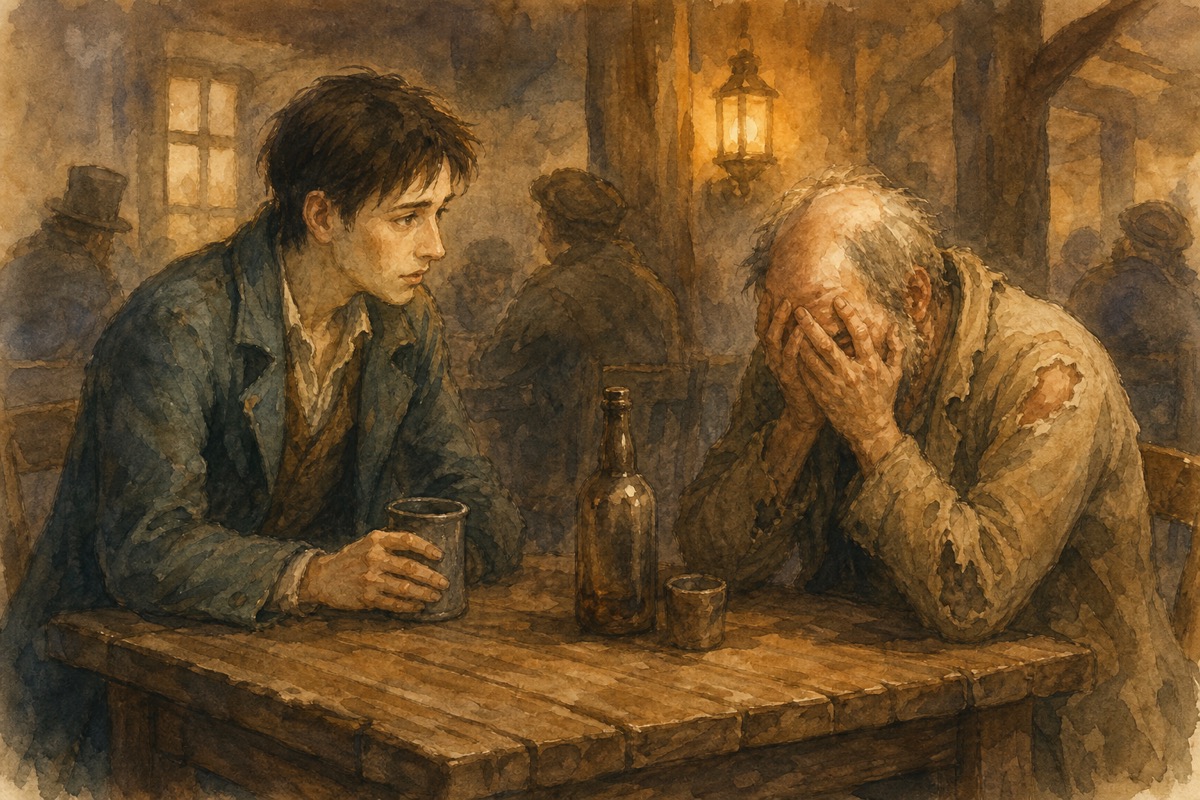
It was a suffocating hot evening in July. A thin, pale student slipped out of his tiny attic room. He hoped no one would see him, especially not his landlady in the open kitchen doorway, with the steam and gossip. His name was Rodion, but everyone called him Raskolnikov. He had been hungry for too long. In his head, a thought was growing—a thought he tried to pretend was just a game, but it led him across the bridge to a house where an old pawnbroker lived. Once, he had pawned his father's old watch there. As the old woman fumbled in her chest for money, he noted everything: which keys she used, where the chest stood, how the bell in the outer door rang with a sharp, hanging jingle. He asked casually if she was alone in the evenings. She answered sourly. Raskolnikov left and almost vomited. He was so tired of his own poverty that even the smell of beer and dust made him angry. He went down to a basement tavern and drank beer for the first time in ages. There he met Marmeladov, a ragged clerk who wept and laughed by turns. Marmeladov told him about his wife Katerina, proud and ill, his starving children, and his stepdaughter Sonia, who had gone out one evening with a scarf around her head and come back with money earned from something everyone was ashamed of. 'He up there will forgive her,' cried Marmeladov, 'He forgives the children of shame.' Raskolnikov could neither go nor stay. He followed the drunk man home.
A Letter from Home
At Marmeladov's home, there was hardly room to breathe. Katerina was thin and irritable, utterly exhausted. Neighbors stood in the doorway staring. Marmeladov begged for blows as if they would comfort him. Raskolnikov felt sick from the smell, the noise, everything. As he left, he put his last coins on the windowsill without a word. Outside, he laughed bitterly at himself, but he could not have taken the money back if he had wanted to. The next morning, the maid Nastasya brought him soup and tea, and a letter from his mother. She wrote that his sister Dunya had suffered injustice from a rich man but was cleared by his wife, and now Dunya had a suitor: Luzhin, a successful gentleman who could arrange a new life for them in Petersburg. They were coming soon, his mother wrote, and would bring money. Raskolnikov lay with wet cheeks after reading. Then his mouth hardened into a tight smile. Never, he thought. Not while I live. He loved Dunya because she endured things he could never manage. He imagined she would marry out of duty: to save their mother, to help him. Sonia had sold herself for bread. Dunya might sell her freedom for security. This made him sick. He wanted to shout stop, but what could he give in return? Then an old idea rose inside him and stared him in the face.
The Terrible Idea
One day on the boulevard, he stopped a well-dressed man following a half-conscious girl. Raskolnikov found a policeman, pressed a coin into his hand, and walked away. Soon he shouted over his shoulder to leave the girl alone—what was it to him? The policeman did his job anyway. Raskolnikov sat on a bench and grew cold. In his head, the sharp doorbell of the old pawnbroker's apartment rang again. He dozed on an island and dreamed he was a little boy watching a scrawny horse beaten to death by drunken men. He embraced the horse's head and wept. When he woke, he decided: No. He would not do it. But then he happened to meet Lizaveta, the meek sister of the old woman. He heard her say she would be away tomorrow at seven o'clock. Then 'no' became a time of day. His whole body seemed to lean into those seven strikes. He sewed a loop inside his coat to hide an axe head. He wrapped a block of wood in cloth to look like a pledge. He planned to take the axe from the kitchen, but Nastasya was there. Then he suddenly saw an axe handle under a bench in the porter's room. It felt as if bad luck itself was helping him. A tall hay wagon rolled in and hid him as he slipped through the gate. He climbed the stairs. He rang the bell. The old woman peered through the crack, curious and sharp. He held out his parcel. She turned her back to open it.
The Unthinkable Act
Before he knew it, his arm swung. He struck once. Then again. She fell silently like an empty sack. It was like doing a job he didn't think about. The blood should have shocked him, but he was just hot and sweaty. He took the keys. He fumbled in drawers and chests, finding little things of gold and silver, some trinkets tied with string. He stuffed them in his pockets. Then he heard a sound. In the doorway stood Lizaveta, a parcel under her arm, her hands raised—not to strike, only to plead. Raskolnikov let his arm fall again. It was over. He washed the axe and his hands as best he could in a dirty basin. He noticed the outer door was ajar, hooked it, and held his breath. Then the bell rang. Voices on the stairs. Two men. They went to fetch the porter. While they were away, he slipped the hook off and opened the door into an empty stairwell. He locked it, walked calmly across the landing, slipped into the apartment of the painters on the floor below, hid behind the jamb as someone pounded past shouting. Then he went down, out, put the axe back, and got home. On his bed, he felt struck by his own hand. He tore off bits of his trouser leg where blood had dried. He hid the trinkets behind a loose piece of wallpaper, but was scared of everything and everyone. A summons in green wax: to the police station. He went, pale-faced, but it was only about an old debt the landlady had sold. He nearly hugged the clerk with relief. They talked across the room about a double murder of an old woman and her sister. A small detail pricked him: the door had first been hooked from inside, but then it was suddenly open when the witnesses returned. He fainted. They asked him where he had been at seven o'clock. 'Out. Sick.' They let him go.
Sickness and Visitors
He realized the hiding place was stupid. Later, he found a heavy stone in a courtyard, heaved it up with all his strength, and put all the stolen goods underneath. No one would lift it. He laughed soundlessly. Raskolnikov fell ill. His friend Razumihin came storming in, scolding, cooking soup, making the bed, getting a doctor, flattering the landlady, even tearing up a debt note. Doctor Zossimov said Rodion must sleep, eat, and not read difficult books. But his body was like an animal in its den. His head was awake. He lay still and let them care for him, but inside something twisted. One evening he was unusually clear and cold. He heard that Lizaveta, too, had been killed. He stared blankly. Then came Luzhin, his sister's fiancé, neatly dressed and proud of himself. He talked at length about how smart it was to help oneself first, then everyone else would be helped. Raskolnikov asked calmly if he liked Dunya best because she was poor. Luzhin became angry and left. Out in the city, Raskolnikov met Zametov from the police. He played with him like a cat, and suddenly whispered, 'What if I did it?' Zametov went white, smiled too broadly, and Rodion left with his heart pounding. He saw a woman go over a bridge railing to jump into the river. People pulled her up. He only felt nausea. Without understanding why, he went back to the house with the sharp jingling bell. Workmen were pasting up new wallpaper. He stood there ringing three times, asking dreamily where the blood had been. They stared. Someone asked who he was. He gave his name and address and wandered away.
Death in the Street
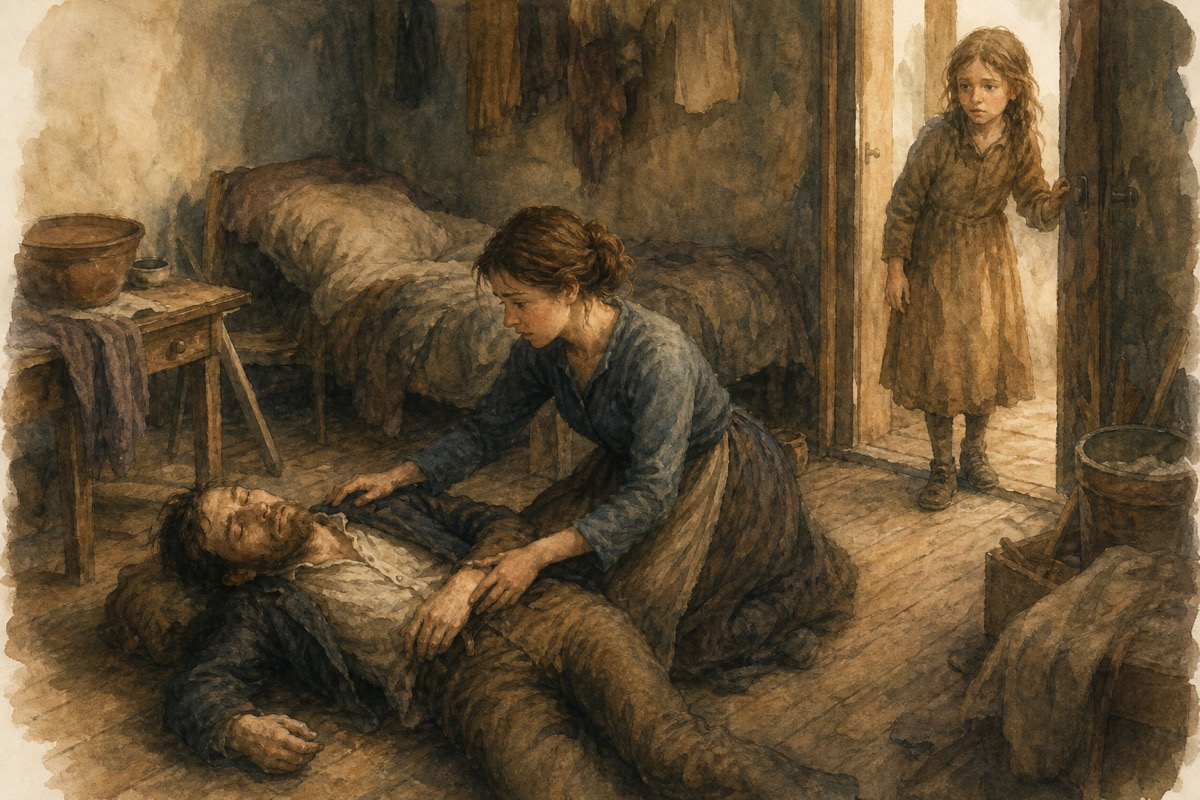
Suddenly there was shouting in the street. A carriage had run over a man. Raskolnikov pushed through and knelt: it was Marmeladov. He shouted for them to carry him home. He promised to pay the doctor. Everyone followed to the cramped room. Katerina gave orders and wept, holding back curious neighbors, washing the children, calling for a pillow and a priest all at once. When Sonia came, in a cheap dress with a little feather in her hat, Marmeladov raised himself to see her. He died with his forehead against her hand. Raskolnikov gave all the money he had to Katerina and whispered to the policeman to be kind to the widow. 'You are stained with blood,' said the policeman, but Rodion just left. On the bridge, he felt almost alive for the first time in ages. He laughed at having whispered to the little girl Polenka to remember his name when she prayed. Later, he went to Razumihin's, where there was tea and warmth, and told him he had given everything to the widow. Then he was suddenly sick and weak again. At home, something both light and heavy awaited: his mother and sister. They fell on him with joy and terror, and he fainted. Razumihin arranged everything for them too. The next day, when he woke, their love was so close he could hardly bear it. He asked them to leave and come back tomorrow. He unfolded one decision like a nail in the room: Dunya must break the engagement. Luzhin must go. His mother burst into tears. Razumihin almost kindly carried them out into the stairway, promising everything, even to pour two buckets of cold water over himself if he said anything foolish again.
A Meeting and a Promise
Luzhin sent a sharp letter: he would only meet Dunya and her mother without Raskolnikov. Moreover, he 'noticed' that Rodion, 'being so ill,' had given a good amount of money to 'a certain young woman of ill repute.' Dunya said dryly that her brother must come. They went to him in the morning. He was washed and combed, almost polite. He thanked Razumihin properly, then suddenly said that perhaps one should not help the poor if one had no 'right' to do so. Dunya met this with a firm no. He blushed and withdrew it. His mother stammered that the wife of Svidrigailov—the rich man who had tormented Dunya before—had died suddenly. Raskolnikov laughed without mirth. He was sad and cold at the same time: he could no longer say anything straight out. Everything inside him lay like a wall between him and others. They decided to all meet with Luzhin that evening. Dunya said she was marrying for her own sake, not to save anyone. Raskolnikov said he would rather have one scoundrel in the family than two. Dunya held his gaze. His mother only asked softly if he would come at eight. He nodded. Then there was a soft knock at the door. Sonia stood there with a small parasol. She asked barely audibly if he would come to her father's memorial service, and perhaps eat with them afterward. She was red with shame for asking. His mother stiffened, but Dunya looked kindly. Raskolnikov promised to come and asked for her address. In the courtyard later, a well-dressed man stood listening—Svidrigailov, unnoticed by Sonia or Rodion. He smiled to himself and followed Sonia at a distance, as if measuring steps and turns.
The Clever Investigator
Raskolnikov went to the examining magistrate Porfiry with Razumihin. He wanted to reclaim the small items he had pawned with the old woman, a good reason to visit the police 'voluntarily.' Porfiry was round and polite, but his eyes laughed silently. Zametov was there too. They drank tea, talked about laws, and Porfiry mentioned a short essay Raskolnikov had written earlier: that a few people in history are allowed to break rules for a great idea. 'Do you believe in resurrection too?' asked Porfiry suddenly. 'Yes,' answered Raskolnikov shortly. Porfiry asked almost playfully whether the author himself thought he was a little 'extraordinary.' 'If I were going to step over something,' replied Raskolnikov, 'I would hardly come and tell you about it.' Zametov laughed too loudly. Porfiry smiled more thinly. Finally, almost as if he had just thought of it at the door, Porfiry asked, 'By the way, did you see the painters on the second floor that evening?' Raskolnikov answered cautiously that he had seen some porters struggling with a sofa on the fourth floor, but no painters. Out on the stairs, Razumihin shouted that the painters had been there on the night of the murder. 'Oh, I always mix up days,' grinned Porfiry, slapping his forehead. Later, Raskolnikov explained sharply to Razumihin that it was in small details one gets caught. If he had said he saw the painters, the date would have trapped him. Porfiry had perhaps hoped for that very snare. In the courtyard later, a short man in a greasy cap stared at him and said lowly, almost contentedly, 'Murderer.' They walked side by side a hundred steps. 'Who is the murderer?' asked Raskolnikov. 'You are the murderer,' repeated the man and disappeared. Rodion lay on his sofa and shivered. He hated himself, and also hated the love that could expose him. He laughed bitterly at the thought he had had of 'killing an idea.' He had only killed.
The Gospel and the Accusation
At Sonia's room, it was quiet. She lived in a cramped room in a tailor's family. On the table lay a small, worn book. They spoke softly. He asked her to read the story of Lazarus being raised to life. She read, her voice growing clearer with each verse, as if the words lit candles. Raskolnikov kept his hands clenched. When he left, he knew he would come back. At Katerina's the next day, there was the memorial service. People came to eat and talk. Luzhin came too, ingratiating and fussy. In the middle of the speeches, he suddenly shouted that someone had taken a banknote from him. He pointed at Sonia. Everyone froze. Katerina turned crimson. Sonia went white. Luzhin asked her to empty her pockets. There was the note. A wall of shame rose around her. Then Lebeziatnikov—a tiresome but honest young man—jumped up and shouted that he had seen Luzhin himself slip the note into her pocket. Raskolnikov broke in, put his hands on the table, and explained what had happened. People turned away from Luzhin. He fumed with anger and had to leave. Sonia stood with trembling hands, wanting to sink through the floor. Afterward, Katerina snapped. Grief, illness, poverty—all fell on her. She took her children into the street and began to sing and dance to collect money for the rent. She coughed blood. She fainted. Raskolnikov, Sonia, and neighbors carried her home. She died that evening, quiet and stiff in the neck, as if still holding up the whole world by will. Sonia was left with the children and nothing.
The Confession
In the evening, Raskolnikov went to Sonia again. He said almost nothing. He walked a few steps back and forth, as if the floor were a narrow bridge. Then he said it: 'It was I.' She stared. When she understood what words those were, she put her hand over her mouth, took it away, moved her lips soundlessly. She did not cry. She moved carefully closer, as if he were wounded. 'What have you done to yourself?' she whispered. He was angry at himself, angry at everything. She put a small brass cross into his hand. 'Bear it. Go and say it. I will follow you.' He almost snatched his hand away, but still held the cross tight in his pocket when he left. That same night, Svidrigailov overheard everything through the wall. He lived in the room next door, as if he had known he must listen. The next day, he met Raskolnikov on the street and said straight out who he was. He laughed, but it was not a happy laugh. He said he could help Dunya with money, help Katerina's children, and could make things worse if it suited him. He wanted to talk to Dunya, without her brother. Raskolnikov felt as if ropes were tightening around everyone he loved. He went to Porfiry again. Porfiry spoke calmly, like an uncle. 'I know everything,' he said, 'but I have no proof. Listen now. Go and say it yourself. Go early. It will make the punishment lighter. And... it will save you.' Raskolnikov jumped up, angry and afraid, but Porfiry led him almost kindly to the door. 'I am waiting,' he said softly.
The Final Temptation
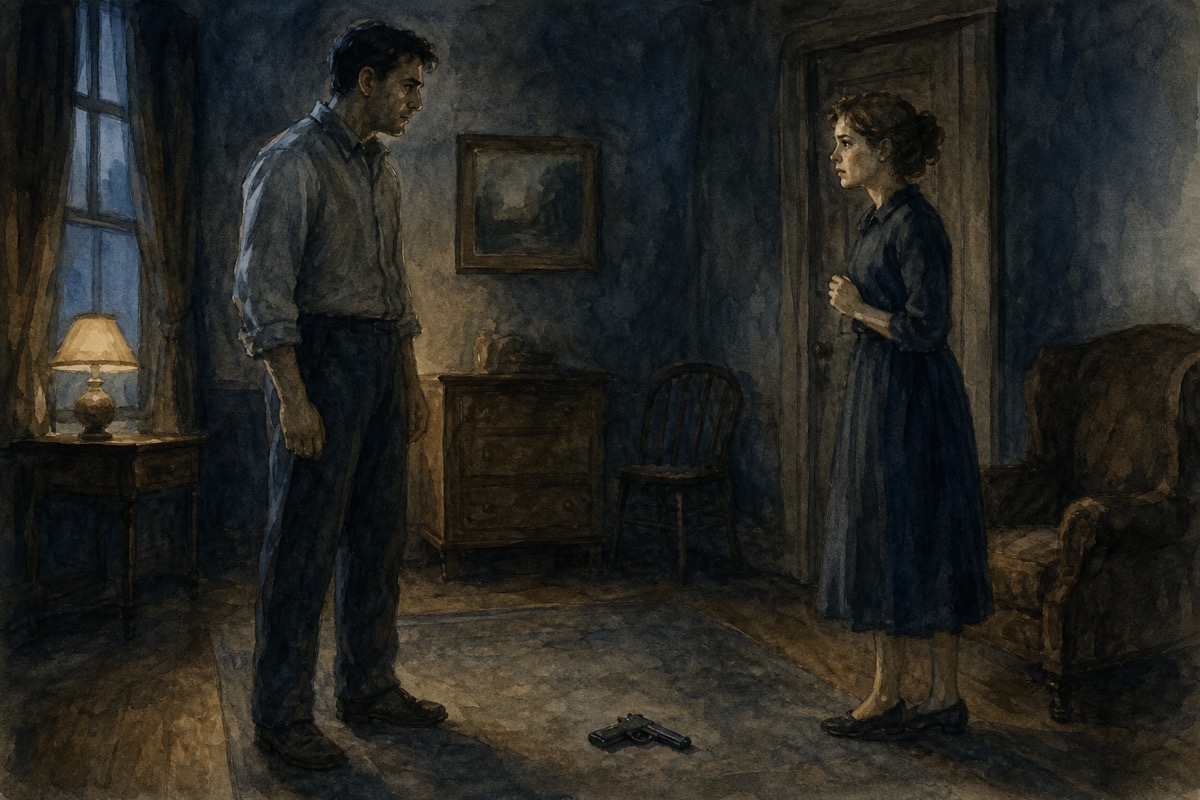
Svidrigailov sent word to Dunya: he could tell her something about her brother. She went to meet him, her back straight. He locked the door. He spoke warmly and lowly, offered her money, flattery, freedom to help her mother and brother, an apartment of her own—all she needed—only if she came to him. He stepped closer. She took out a small pistol. He told her to shoot if she wanted. She fired, but the bullet only grazed. She dropped the pistol, bent down, and begged him to let her pass. He saw the world's sharpest no in her eyes and stepped aside. 'Go,' he said, almost surprised at his own voice. When she disappeared down the stairs, he stood still for a long time. That evening, he walked around the city as if he were finished. He gave money to a confused teenage girl, paid for a poor wedding, sent large sums to Sonia for the children. He slept little, drank coffee in the cold morning. Before the sun had climbed, he went out into the rainy air, smiled kindly at a guard, and ended his own life. People found him and shook their heads. They said all sorts of things. But whoever had seen Dunya's look knew that Svidrigailov was already gone when she left. Raskolnikov also wandered through the morning, long and fast. He passed the police station and passed it again. The cramps in his chest would not let go. He found Sonia. She took out his cross and tied it to her own string. 'Go,' she said, quite calmly. 'I am over there.'
The Public Confession
He went out to the square. He knelt on the dirty stones and kissed the ground, in the midst of everyone's feet. Some laughed. Some pointed. An old woman made the sign of the cross. Raskolnikov rose and went into the police station. Inside there was noise: they were talking about a rich man who had shot himself that morning. 'Svidrigailov,' someone said. Raskolnikov's heart stopped for a short beat. Then he said, softly at first, then more clearly: 'I am the one who killed the pawnbroker and her sister.' A clerk's pen fell on the table. Another just looked at him, and it was almost good, like being seen properly for the first time in months. Porfiry came. He nodded almost sadly. He had long hoped for this morning. 'You came yourself,' he said, 'that was right.' He did not clap, he did not laugh. He just began on the papers. The trial took time. Many people said many things. A painter had confessed something, but it did not hold. Raskolnikov told everything. How small his idea had been, how large the shadow it cast. Everything he had thrown away—and everything he still did not understand. The sentence fell: many years of hard labor in Siberia. He said almost nothing. His mother quietly broke down and died soon after, with her son's name on her lips, but without knowing the whole truth. Dunya and Razumihin held each other's hands and wept. They held on to life. They married quietly, without grand words. They visited Sonia, who went every day to the children and kept accounts of every crumb of bread, every shoe, every day.
The Long Road
The road east was long. It was cold and dusty by turns. In carts and on rivers, prisoners were transported far from the city. The view was wide and flat. Raskolnikov stared at the river flowing, at the birches gleaming white in the twilight, and at his hands. He thought about everything and nothing. Then, in a small town in Siberia, in barracks of plank with stoves that smelled of soot, a new life began that could hardly be called life. The work was heavy. The nights were full of dreams he no longer believed in. He often looked down. He spoke little. The other convicts did not like him much. They recognized his silence as something dangerous. He wore Sonia's cross, but inside it was dark and empty. One day, she came. Sonia had sold almost everything she owned, traveled in dirty carts and on icy paths, and came through the door with a small bundle in her hand: bread, a little tea, some cloth patches, a worn book. She smiled, shy, so glad she hardly dared look at him. He could not smile back. But he breathed deeper. She came back the next day. And the next. Small words, small deeds, like breadcrumbs all the way home.
A New Dawn
Time passed. Winter and spring traded places, as always. Raskolnikov fell ill. He lay for a long time, crying out in fever. In his dream, the city from before was a land of darkness with strange customs, and everyone thought they were right and did one after another harm without understanding anything. He woke exhausted, while Sonia sat by his bed reading quietly. The New Testament lay under his pillow. She did not put it there to press him down. She placed it there like a door left ajar. One evening, he went out alone. The wind pulled at his shirt through the gaps in his jacket. Outside the barracks, he stopped and looked at the sky. It was larger than he remembered, with stars that did not know his name, but that did not make him smaller. He went back and sat at the table. The book was there. He opened it slowly and read about someone who wept at a friend's grave and called him out of the darkness. The words were the same as before in Sonia's voice, but now they also slipped into him. When he met Sonia the next day, he looked at her as if seeing her for the first time. He stretched out his hand. She took it. He bent his head and wept quietly, and she wept too, but not heavily. There was a peace afterward, like when a very tired body finally falls asleep without nightmares.
Beginning of a New Story
The next months were not easy. The work was still heavy. Many were still angry. He was still condemned. He was not 'free.' But he wore his cross because he wanted to, not because someone forced him. That made a small difference, but a real one. Dunya and Razumihin wrote letters full of everyday light: a pot that would not sit straight, a small gift from a friend, a stain on a cloth that would not come out, their laughter amid everything. They saved, they planned, they waited. They did not ask him to become a hero. They asked him to become a person who could sit at the table and eat with them one evening without being ashamed or hiding. Sonia went back and forth between the barracks and the town, between the children who needed her, neighbors who used her thin shoulders, and the one man who had been darker than night, but who now looked at the world with eyes that understood a little more each day. When spring came again and the ice broke free in large slabs, she and Raskolnikov stood by the riverbank. The water flowed past, and they said nothing. They did not need to. He had begun a long road, and it was not wide or straight. It was not without stones. But it was a road. It was the beginning of a new story, not about how clever he once thought he had to be, but about how true a person can become when he finally dares to carry his own heart openly. And on that road, deep inside, there always walked someone beside him with a small book in her hand and a cross on a string, and a look that every single day could say: We try again.