Age-adapted BokRobot book
The Tale of Genji for age 9
Murasaki Shikibu
15 chapters · 15 pages · 3,424 words English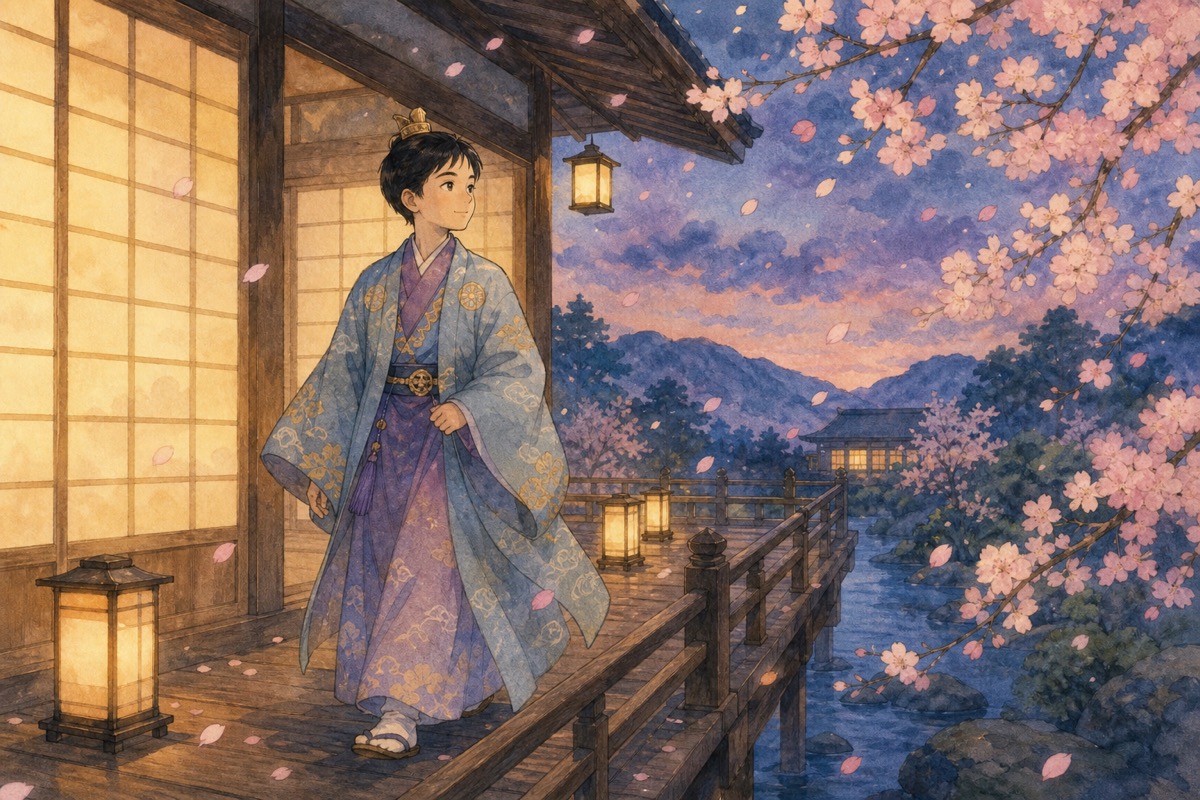
Once upon a time, in a beautiful palace, there lived a young prince named Genji. Everyone admired him because he was kind, clever, and handsome. He was married to a lady named Aoi, who was quiet and graceful. But even though people praised her, Genji felt a little lonely. Aoi was always calm, like a still pond, and Genji sometimes wished she would laugh or cry like other people. One evening, an astrologer said that a certain star was making Genji's house unlucky. Genji felt relieved, because now he had an excuse not to go home. Instead, he rode to a simple house where one of his friends lived. The evening was warm, and he walked up and down the veranda, listening to the humming of mosquitoes. Behind the thin paper walls, he heard ladies whispering about him and reciting poems. He smiled, but his heart felt heavy.
Among the young men, Genji noticed a quiet boy with serious eyes. He learned that the boy was the youngest in a family that had once been important. His older sister was now a young stepmother in a house where the husband was away. Genji became curious about this lady. Late that night, when everyone else was asleep, he heard two voices through the wall—the boy and a sleepy, gentle voice. They were talking about him! Genji quietly slid the door open a little and found himself face to face with a tiny woman who thought he was a servant. He quickly apologized and said he only wanted to talk. She was so scared and shy that she could barely speak. She was not proud or angry, just firm like a young bamboo that will not bend. When dawn came, he let her go.
At home, Genji could not sleep. He thought about the shy lady and how different she was from everyone else. He decided to help her brother by giving him a job at the palace. Then he wrote her polite letters with poems that were warm but not too forward. She answered with short, wise words. One evening, he visited her again while her husband was away. She hid in a servant's room, pretending to have a backache. Genji waited until everyone was asleep. With the boy's help, he crept into the darkness, following the scent of perfume. But the woman he found was not the shy lady—she was a round, laughing girl who thought he had come for her. The real lady escaped, leaving behind only a thin scarf. In the morning, Genji kept the scarf as a memory. He and the shy lady both knew who he had really come for, and a mixture of guilt and admiration filled his heart.
One day, Genji's old nurse, who had become a nun, fell ill. While waiting at the gate of her small house, Genji noticed a poor trellis with pale flowers that only bloom in the evening. They sparkled with dew. A little girl came out and handed him a white fan with a poem written on it: 'These are evening faces.' Genji was delighted. He began a kind secret—with the help of the nurse's son, he visited the lady who lived in that house. She was quiet and simple, living high up under the roof. There was no fancy furniture or ceremonies. She was not used to taking care of herself. Genji did not tell her who he was. He came in a simple jacket, with only one servant waiting on the corner. She was afraid he might be a fox spirit in human form. He was afraid that the city would find out and she would disappear. Between fear and tenderness, they promised to be true. It was so easy that it frightened him.
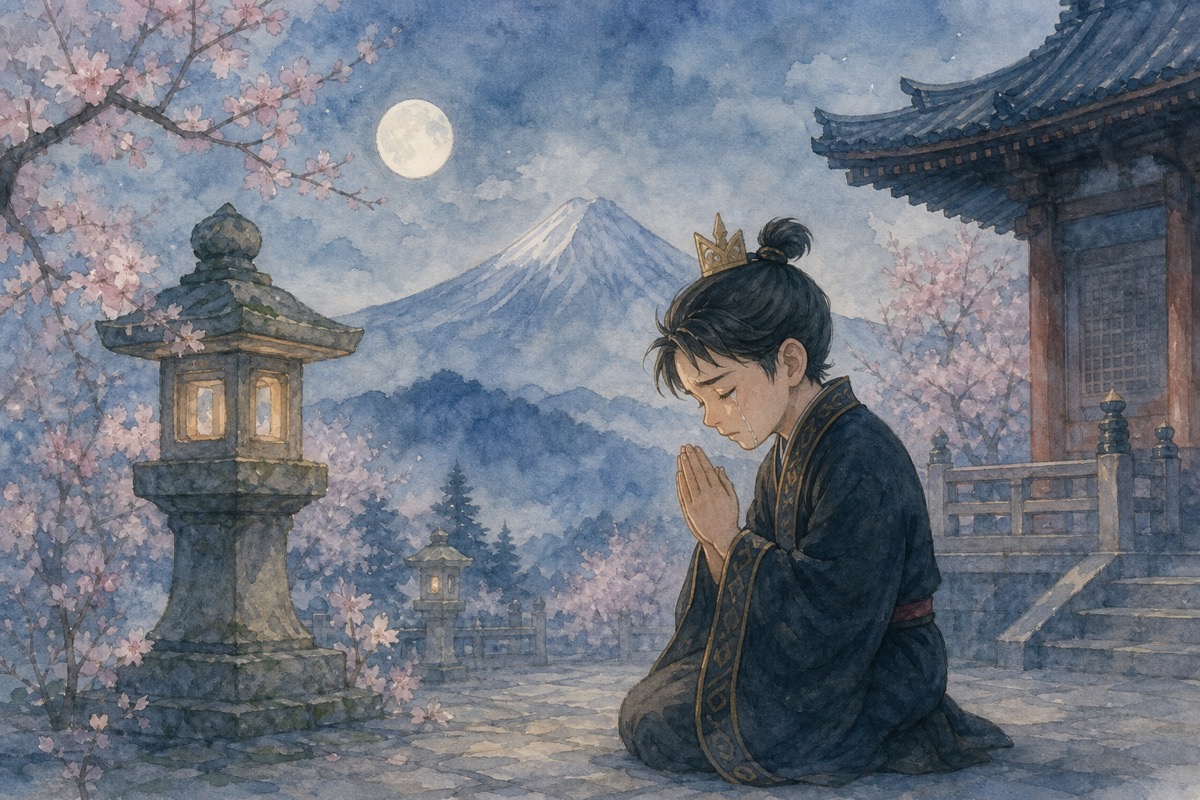
Genji wanted to protect the quiet lady from gossip. He took her to an empty mansion with large rooms and overgrown ponds. The caretaker was loyal and kept the secret. But the lady, who had never been afraid before, now became frightened. Why would a prince choose a deserted house? Genji laughed and comforted her. They fell asleep. In the middle of the night, Genji dreamed of a tall, proud woman with a cold gaze who tried to pull his friend away. He clapped his hands, but the sound disappeared. The lamps went out. His beloved trembled, breathed heavily, and then became still. Genji talked and talked, trying to bring her back. But she grew cold. The nurse's son came with tears and told Genji to flee—the city would sing songs about this. Genji carried her small body like a child. She was taken to a mountain temple. Genji fell ill with fever. On the seventeenth night, he rode in disguise to the temple, fell into a ditch, prayed to the merciful goddess, and saw her face—never to blush again. He cried like a boy. Even in his dreams, he found no comfort, only the shadow of the proud lady from the city. Jealousy, people say, does not die with the body.
The servant girl Ukon told Genji a secret the dead lady had hidden: she had once been loved by Genji's best friend, and had a child she had to hide away. Everything that had been sweet now tasted sad. Genji fell ill again. A wise healer in the northern mountains was summoned. Genji went there in disguise. The old man whispered kind words and tied small prayer slips that carried him through the night. As Genji left, he looked down at some small houses in a valley. At one house with a tidy gate and a few trees, a flock of little girls ran out. One of them stopped his heart for a moment. Her face, messy from crying over a lost bird, was beautiful in a way he recognized but didn't know why. An old nun was stroking her hair. A nurse was scolding a boy. The old priest told Genji that a nun, sister of a great lord, lived there. Her daughter had once refused the court, had a difficult marriage, and died. The little girl was her child. Genji saw that she was the image of the woman he had loved first and most. He asked to take the girl with him. The nun politely refused—she was too young. Genji wrote a poem about dew clinging to a leaf, and the nun answered wisely. 'In four or five years, perhaps,' she said. Genji carried the scent of hidden incense, the nun's pure letter, and the child's quick face down the mountain.
Back in the city, the Emperor smiled and praised Genji for his journey. Aoi was as proud and cool as ever. Meanwhile, Fujitsubo, the lady Genji had never been able to forget, fell ill. A faithful lady-in-waiting carried secret letters between them. Then the nun in the mountains died suddenly. In the pouring rain, Genji went to her house. Through the walls, he heard his own name, and a trembling voice asking: if he still meant it, would he take the little girl to live among his women, safely? The girl woke up and called out like only a child can: 'Is the handsome prince here?' Her voice filled his chest with light. Soon a great lord came to take the child to his house. She cried. Before dawn, Genji came with one servant, crept in like a thief, and told the little girl—gently—that her father had sent him. The nurse packed quickly, crying at the broken promise but knowing the tide cannot be stopped. Genji took them to his western wing. He brought four little friends so she wouldn't be lonely, and every day she grew wiser and kinder. He wrote a poem about the Musashi plain for her on purple paper. She wrote back clumsily that she didn't understand all about plants and family. He laughed gently and called her Murasaki, which means 'purple.'
Rumors grew. Who was the hidden lady keeping the shining prince away from everyone? People made up stories: a kidnapped maid, a secret empress. Genji endured the Emperor's gentle scolding for being too cold to friendly ladies. Then came a great dance rehearsal in the red courtyard. Genji danced 'Waves of the Blue Sea' so gracefully that even princes wept. At the real festival, the wind blew and maple leaves sang; the whole court cried as if the season itself had risen in his dance steps. Rewards rained down. He went home to the little girl, who was laughing over a paintbrush and a toy. She didn't care about a man who made grown men cry with a few slow steps. At the same time, a secret grew: Fujitsubo was expecting a child. Priests were summoned in secret. In the second month, a baby boy was born. The Emperor thanked the gods with an unusually loud voice. Fujitsubo fought for her life. Genji sent a small pink flower and a poem about a flower that was his and not his. When the baby was shown at the fourth month ceremony, the Emperor placed him in Genji's arms and smiled: the resemblance to a young Genji was too clear. Genji wanted to sink through the floor. That night he slept badly. He played his flute softly by Murasaki's bed until his unease turned to a quiet hum.
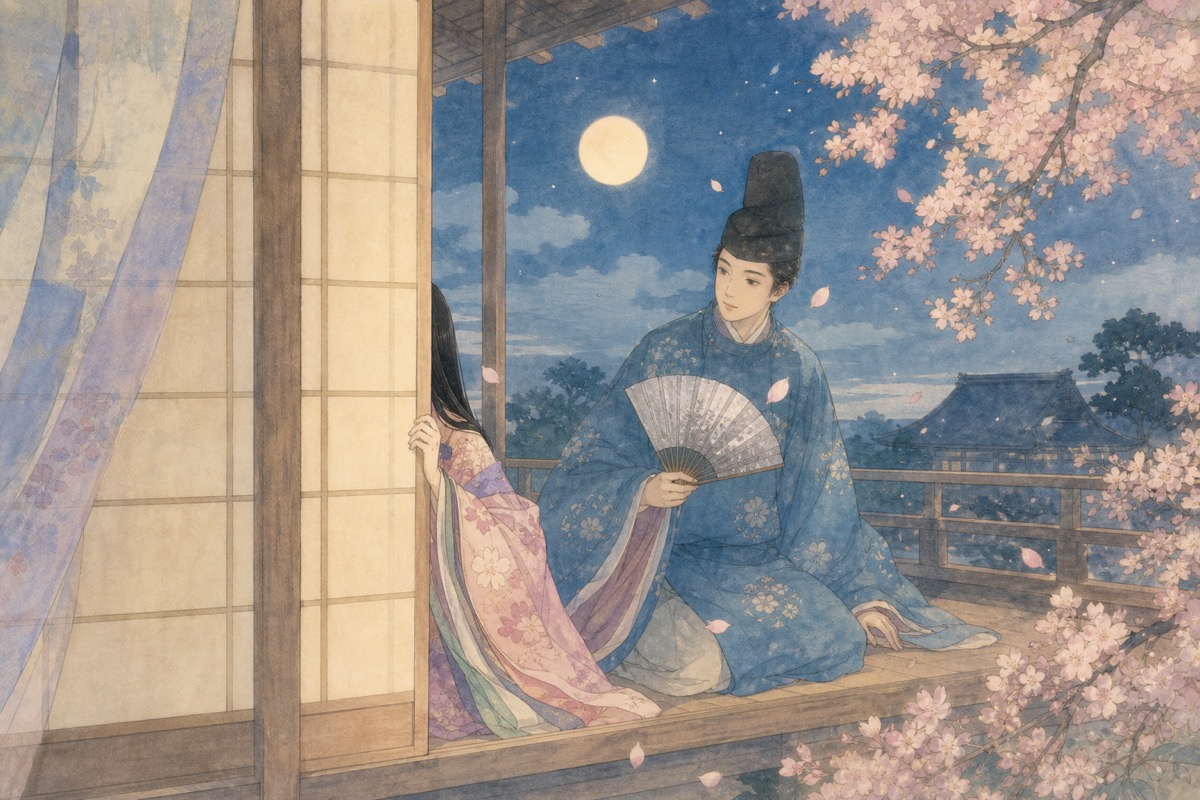
Not everything was sad. An older lady at court flirted awkwardly, and Genji teased her gently. The Emperor walked by and laughed. Genji's best friend, To no Chujo, made up stories about it and even played a night prank that ended in a tangle of cloaks and a sword stuck fast. Through all the fun, their friendship grew warmer and sharper. The Emperor made Fujitsubo his empress and Genji an advisor. At the Blossom Festival under the great cherry tree, the old Emperor himself commanded a poem. Genji read so clearly that the heir begged him to dance again. Moonlight and wine made Genji bold. After the festival, as he passed Koukiden's quiet rooms, he saw a door slightly open. A girl's sleeve lay there. She was singing softly about a hazy moon. He answered with a verse about a night kind to those who wait. The door moved almost by itself. A young voice that knew his voice more than his face said no a few times and then fell silent. At dawn, he fled with a silver fan painted with the moon reflected in water, and a little question written on the edge: 'Where does the moon go at dawn?' He guessed she was the younger sister of Koukiden's house, soon promised to the heir.
A lively lady named Myobu told Genji about a lonely princess, the daughter of Prince Hitachi. She had been raised like a rare plant but was left without protection. Genji, always curious about the unusual, went in disguise to hear her play the koto through a night lattice. His friend To no Chujo followed for fun. Genji exchanged poems with Myobu and a servant who shielded the frightened princess. He saw a tall woman with hair like a river, but not beautiful by court standards. He felt pity and kindness. He sent warm blankets to the old gatekeeper and clothes in soft colors to teach her beauty through fabric. She sent back a clumsily sewn jacket and a heavy little poem about wet sleeves. He replied with friendly wit. He was gentle with her and never laughed at what others laughed at. At a great wisteria festival, he recognized a soft voice behind a screen, and the moon fan in his sleeve made his heart uneasy.
The great Kamo processions arrived, with half the court on horseback and the rest under flowering canopies. Genji was ordered to ride. Aoi, who usually stayed behind, was asked to watch from a carriage. The streets were narrow, the carriages heavy. Two light basket carriages refused to yield. Men with Aoi's carriage, and some of Genji's men who recognized Lady Rokujo's servants, pushed and shoved. Axles broke. Lady Rokujo had hoped this bright day would lift her spirits. Instead, she was humiliated in the middle of the crowd, while Genji, the sun of the day, rode by and bowed politely to Aoi's curtain. The shame stung. Genji went to apologize. She refused. His patience wore thin. Soon after, Aoi fell ill in a way that scared everyone. Exorcists and singers filled the main hall. Some said evil will was loose. Lady Rokujo dreamed she had grabbed Aoi and shaken her. She woke with the smell of mustard incense in her sleeves and a feeling of being displaced in time and body. She feared her own thoughts. Priests prayed, but relief did not come.
Aoi's labor came too early and too hard. The room was filled with prayers and talismans. Someone holding Aoi asked to speak to the prince through her mouth. Genji came behind the curtain. Aoi lay there, pale and gentle in white, her hair loose. A soft voice spoke words he knew too well. He whispered and asked questions, and the voice answered. For a moment, the grip loosened. Aoi gathered all her strength and gave birth to a son. Joy hid the terror for a while. The priests cried victory. But it came back, as if something ashamed remembered itself and ran back. Aoi lay long on the edge between here and there, and then she was gone. Toribeno, like a great unwanted plain, glowed with funeral pyres on an early autumn day. Row after row of family and attendants came to pay their respects. Genji, who had mostly met death in stories, stood under a meaningless sky and whispered that clouds were now smoke and smoke clouds, and that everything that rises carries something of her. Back in the great hall, he put on mourning and spoke with a simplicity that moved people more than all his splendor ever had.
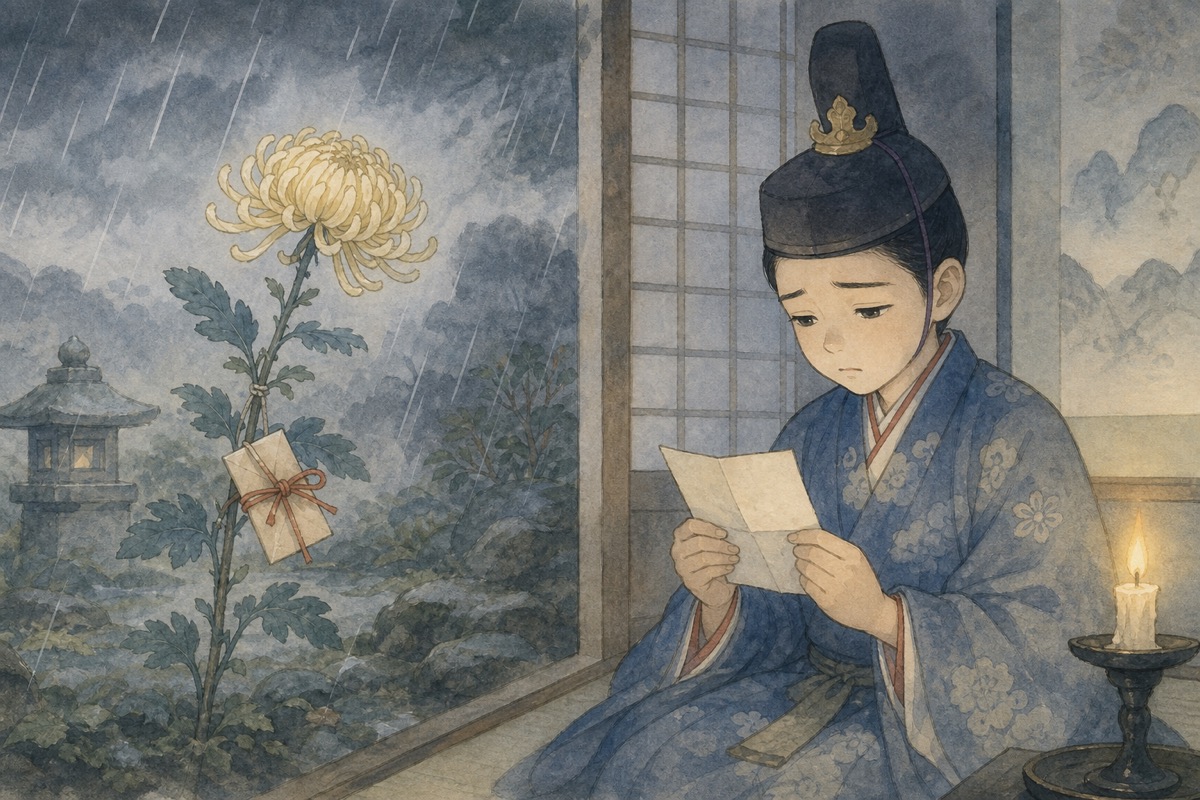
At dawn, a letter arrived for Genji, tied to a chrysanthemum in the rain. The handwriting was unforgettable. The word 'kiku' could mean both 'chrysanthemum' and 'to listen.' He put the letter aside—and took it up again. He replied with a poem about dew and a plea not to brood herself ill. The lady who read the reply heard what was not written: he suspected her. Guilt, which she had never felt before, grew like mold. She thought bitterly that she had once refused to live safely with the old Emperor, and later let Genji lure her into the light. After the humiliation at the river, new suitors came to her palace as if it were a stage. Genji heard about it. He blamed no one, but thought it was a pity. He knew the isolation she contemplated could harm her as much as the city's gossip could harm him. Grief settled into him like a guest demanding space. His friend To no Chujo came often, with news and chatter, and once to laugh about the old lady's night prank. They wrote poems to each other in the rain on a southern balcony, and through the words, Chujo understood how deep the bond had been, despite all the distance.
Genji sent a bouquet of late-blooming bluebells to Murasaki's grandmother through the nurse, with a line about foolishly sending a humble flower to remind of another autumn. They cried in that house. He wrote to Princess Asagao with cautious words, and her stiff reply comforted him only by existing. He went to the main hall to distribute Aoi's small keepsakes—combs, boxes, and ornaments—among the ladies, and told an orphaned servant girl that he would take care of her. To himself, he whispered that the road to that house must now be without more breaks. Finally, he went—at last—to the western wing. The wise nurse Shonagon had kept the house in order like a little poem: winter clothes aired, desk tidy, toys in place. When Genji lifted the little honor curtain, Murasaki's profile in the lamplight was so like the lady he had loved first that his knees went soft. He said that his presence would surely tire her out. She didn't answer, but hid her face in her sleeve. In the days that followed, they wrote and played, and laughed when he painted a red dot on the nose of a drawn beauty—and one on his own to make it fair. He, who had always wanted to be wanted first, felt that he must now wish differently: to be safety first. One night, no one saw anything, for not seeing was the whole point. By her pillow, he placed a beautiful writing box with a line about having lived too long under the same little sky of secrets. She understood with a child's unease that something was about to change, and grew warm with fear. He promised: if anything hurt, he would stop. He understood that he had asked something new of innocence, and that answers sometimes come in the body's stillness, not in words.
There are small customs that make a change into a safe path. On the second evening, Genji had the nurse's son bring sweet cakes; on the third, the same but fewer, for that is how people in the city mark gentle transitions. From that week on, he could hardly bear to be away from her room. When he left, he longed to return. He celebrated her coming-of-age quietly and richly. He told himself that he must soon tell her father. He kept other promises silently: he would not entangle himself in more bonds that hurt. About Lady Rokujo, the proud widow, he thought he would be friendly without causing more pain, even if what had been between them could not return. New Year came. Genji wore clothes that the old princess with trembling hands had chosen, sent her an acrostic poem, and received one in return. He visited the Emperor, the heir, and the great hall. One day, he took Murasaki in a carriage to see the Kamo procession. He kept the curtains down and sat quietly with the hidden girl, even when a funny old lady thrust a bent fan with a poem through the window, as if the day were made for such things. Out in the city, rumors circulated about Aoi's death and the possession. The air tasted of accusations. Lady Rokujo could neither choose full retreat nor full city life. She floated like a fish float that never sinks and never rests. Genji went one more time and begged her, not for his sake but for her own, to be gentle with herself. She would neither be used nor forgive. He wrote about Aoi's last days. She replied with a field painting full of regret. He recognized the hand that could cut cleaner lines on paper than anyone else—and he knew that choices he had made little by little had driven her there.