Age-adapted BokRobot book
The Legend of Sleepy Hollow for age 11
The Legend of Sleepy Hollow
Irving, Washington
15 pages · 4,026 words English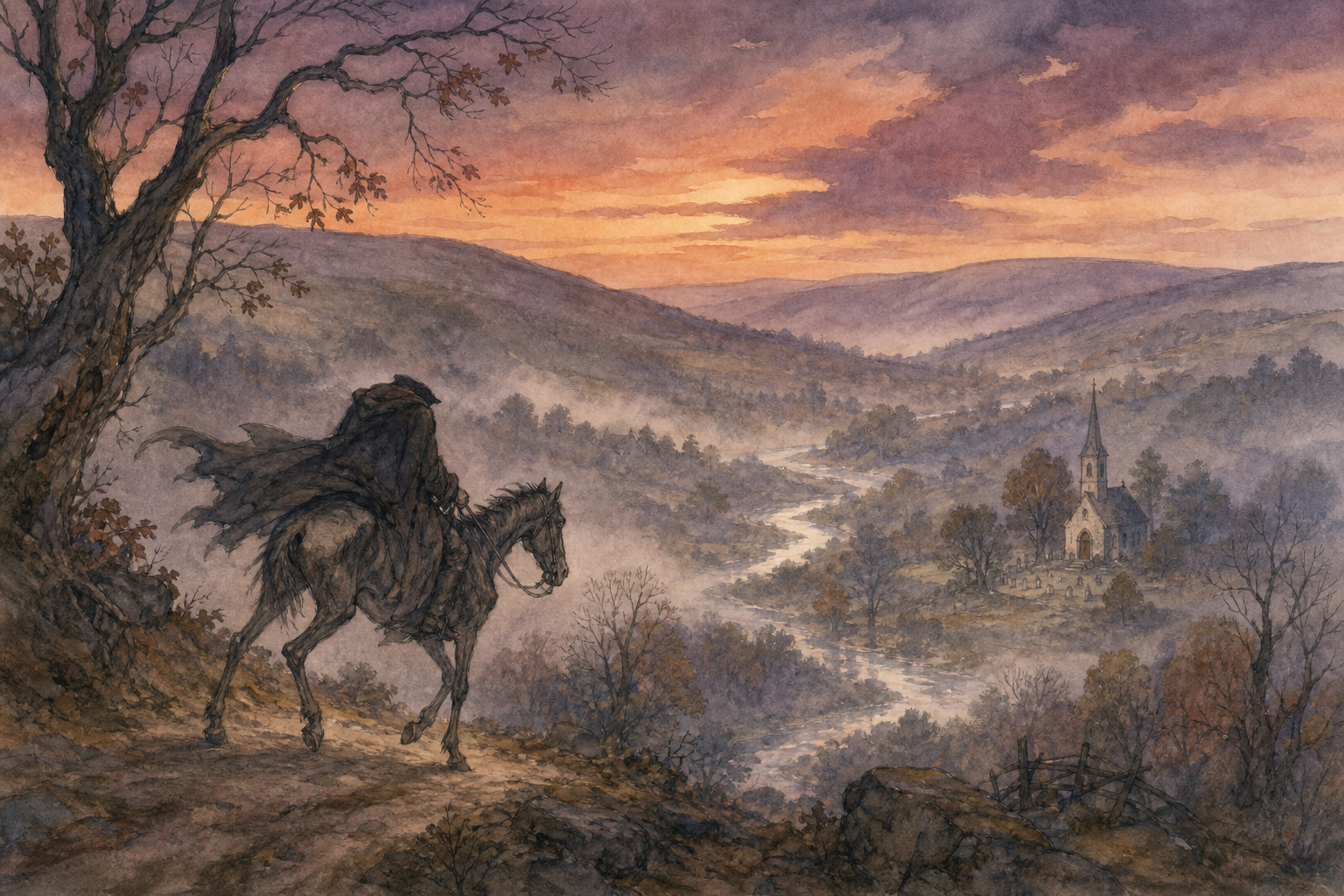
Diedrich Knickerbocker says he is just retelling an old story from the land along the Hudson River. Where the river becomes wide and calm lies Tarry Town, and beyond, in a quiet, green valley, lies Sleepy Hollow. Everything there seems a little enchanted. The light is soft, sounds are muffled, and even the liveliest person becomes dreamy. The people are descendants of the Dutch. They hold tightly to their legends. Often they gather around the hearths and speak of the same figure: the Headless Horseman.
He is said to have been a Hessian soldier during the war of independence. A cannonball took his head. They buried his body in the churchyard by the water. But every night, before dawn, he rides out to search for his head. Some say he carries it on his saddle, like a package. Others say he searches along the roads and by the old bridge. People get used to seeing shadows change in the twilight and to hearing sounds that might be only the wind, or something else. Such is Sleepy Hollow: friendly by day, but with a secret unease when darkness falls. And in the midst of this, thirty years ago, a stranger arrived who did not know the valley's sleepy magic. His name was Ichabod Crane.
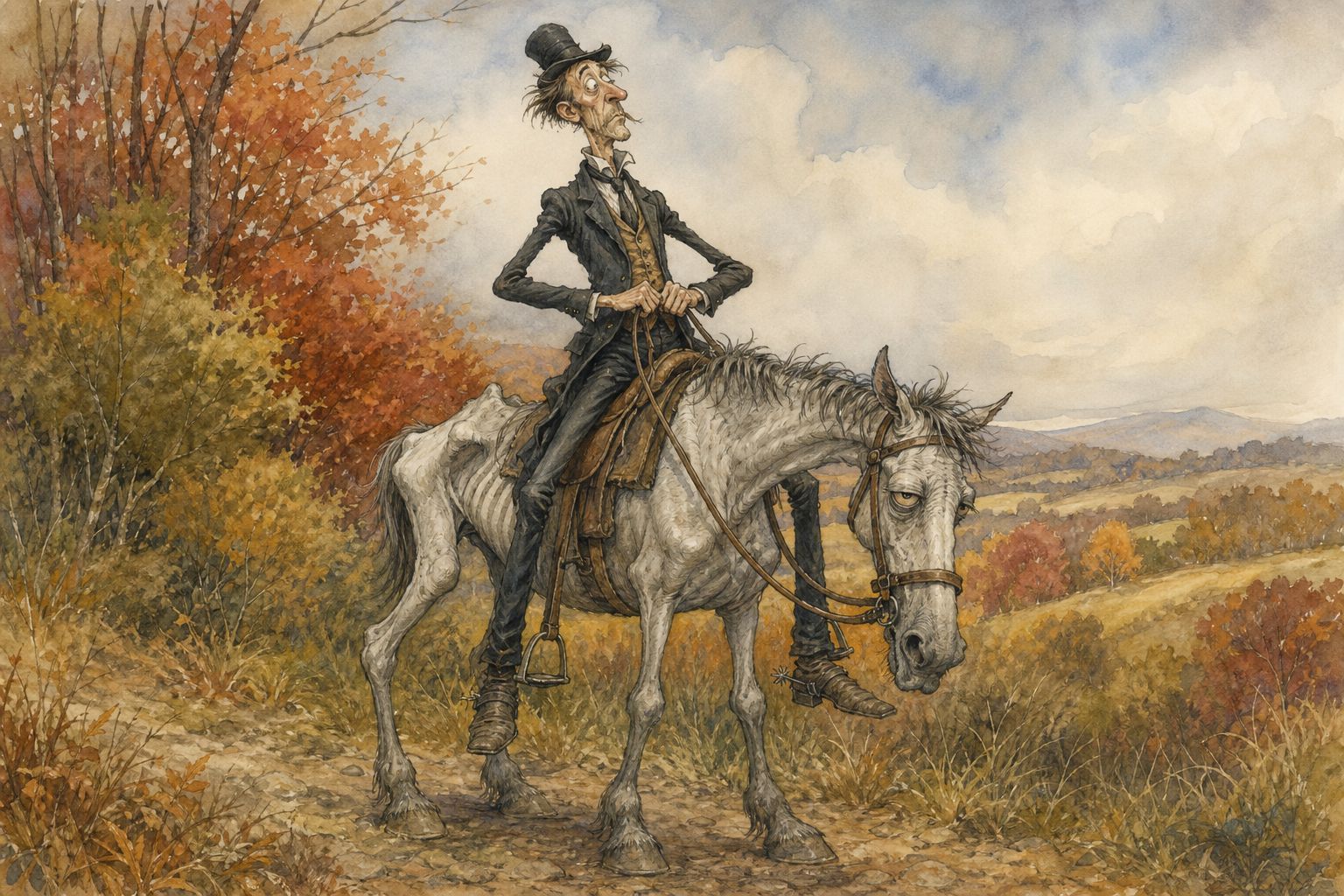
Ichabod Crane was a schoolmaster. He came from Connecticut and stayed in Sleepy Hollow to teach the children. He was tall, thin, and bony. His arms and legs were so long that he might have reminded you of a scarecrow that had broken loose from its post and started walking. His ears stuck out, his nose was long, and his eyes were pale and round. His head seemed small on his thin neck.
The schoolhouse stood alone at the foot of a shady hill. The walls were roughly timbered, and the floor creaked. Every day, the hum of reading, the scratching of quill pens, and Ichabod's sharp warnings filled the room. He punished when he had to, but he was not cruel. Those who were diligent got off lightly. Those who only made mischief got a double dose. After school, he was a guest in the homes where he boarded. He went from farm to farm, paying for his food and lodging with work. He chopped wood, carried water, mended fences, and rocked cradles. He was polite to the wives, laughed at their stories, and remembered every bit of news.
Ichabod had read few books, but those he knew he believed in strongly. One was Cotton Mather's account of witches and wonders in New England. He liked such subjects. Sleepy Hollow was full of stories, and he soaked them in. Often he sat by a fireplace where apples hissed in the ashes, while old Dutch women told of white figures in the woods, of brooks that sang at night, and most of all of the Headless Horseman who thundered over the hills.
In return, Ichabod told about comets he had read about, strange signs in the sky, and omens of weather and fate. All this sank deep into his heart. But the price was that he became easily frightened in the evening. On his way home, a bush in the snow could become a white ghost. A branch rubbing against another sounded like a groan. A beetle knocking in the dark was suddenly a secret sign. Then he would begin to sing hymns to keep his courage up, and his steps would quicken.
By day he laughed at it all. Sun and soup could chase away any darkness. He also had appetite for more than food. His ambition was great. He liked the idea of rising in the world. But it was not a ghost that truly changed his life. It was a girl.
Katrina Van Tassel was eighteen years old, fresh-cheeked and used to being noticed. She was the only child of Baltus Van Tassel, a rich and thrifty farmer. Katrina liked pretty ribbons and new frills, but she also wore heirloom jewelry that glowed warmly. She came to the singing lessons, and Ichabod noticed her at once.
When he first visited the Van Tassel farm, he felt that the door to his fate stood open. The barn was huge, broad-chested, and full of grain sacks. The cows stood calmly chewing. Geese and ducks drifted on the pond like white clouds. Pigeons sat dozing on the eaves. The orchard hung heavy with apples and pears. In the kitchen, pewter dishes gleamed, and strings of dried fruit and red peppers hung from the beams.
Ichabod's imagination awoke fully. He could almost taste the ribs of every pig he saw, and every field seemed like clinking coins. He saw himself as lord of the place. He dreamed on: perhaps he and his future wife would one day travel west, with a lively mare in front, pots clattering behind, and children laughing under the canvas. After that, his studies narrowed to one subject: how to win Katrina.
But the road to Katrina was not empty. She was rich and admired, and many young men tried their luck. Yet there was one who scared the others away. His name was Abraham Van Brunt, but everyone called him Brom Bones. He was broad-shouldered, agile, and strong. He had short, black curls under a fur cap, and a look that liked fun and wanted to be in charge. He was the best horseman in the region. His mare was named Daredevil and was as sly as he.
Brom liked races, wrestling, and small brawls. When neighbors quarreled, he would settle it with sheer strength and a booming laugh. He had courted Katrina for a long time, loudly and boldly. When his horse stood tied at the Van Tassel fence on a Sunday evening, most others stayed away.
Ichabod did not challenge Brom openly. He was not stupid. He was as bendable as a branch in the wind. He kept low when the pressure was on, but rose as soon as it eased. He used his position. He stayed after singing lessons. He walked in the hour when light and shadow exchange places, the hour that often gives heavy words and quick heartbeats. Brom would have liked to settle the matter with fists, but how could he fight a man who always slipped away? Instead he teased Ichabod. He stuffed his pipe so the singing school went up in smoke. He broke into the schoolhouse at night and moved everything around. He laughed at him in front of Katrina. He even taught a dog to howl through its nose, like an ugly shadow of Ichabod's hymn singing. Neither gained an advantage. Neither one won.
One clear autumn day, a black-clad messenger stood in the school doorway. He delivered an invitation: an autumn party at Mynheer Van Tassel's. Ichabod felt new hope. He whipped the students through their lessons, dismissed them with a cheer, and began to prepare as for battle. He owned little. He brushed his best suit, a rusty black one. He smoothed his hair using a small mirror piece that hung in the schoolroom.
He needed a horse. His current host was Hans Van Ripper, a quick-tempered man and an even quicker-tempered rider. He lent his old nag, Gunpowder. The horse was old and thin from many plow hauls. It had one blind eye and one that glowed like an ember. It was crafty and surly, with a certain bossiness once it got its way.
Ichabod did not look elegant on a horse. The stirrups were too short, his elbows stuck out, and his knees hung like knots. But that did not matter to him. He was on his way to opportunity. Around him, autumn blazed with color. The woods were brown and golden. Flocks of birds swooped over the valley. The fields were full of corn stalks and orange pumpkins. The air was thick with the scent of buckwheat and honey. Every smell of richness made his heart lighter. Perhaps this was the evening when everything would fall into place.
The Van Tassel farm was full of people and life. Old farmers with leathery faces stood and chuckled. Wives in crisp caps greeted warmly. Girls in silk ribbons or straw hats walked in pairs, blushing and happy. The boys were dressed in square-tailed coats, their ponytails bound with eelskin. Some dark faces peered in through the windows and laughed too. Brom Bones arrived on Daredevil, and the mare laid her ears back just like her owner.
In the parlor, the table bent under dishes. There were cakes and pies, sausages and hams, pickled things in glasses, butter that shone yellow. Ichabod sat down and did justice to everything offered. For every meal he had grudged himself in the schoolchildren's homes, this stood like a dream. He was not only hungry in his stomach. He liked to imagine that one day he would rule this house, this barn, this orchard. Old Balt Van Tassel moved around like a good-natured harvest moon, urging everyone to eat more. He patted people on the shoulders and laughed with his belly.
Then the dancing began. The fiddle squeaked and sang. Ichabod danced as if every limb were in motion. He was proud when he could lead the singing, but in the dance he became almost drunk. He had the lady of his heart on his arm. Katrina laughed at his eagerness and let him lead. Brom Bones sat a little aside, like a smoldering log. No one who knew him doubted that he noticed everything.
When the fiddle grew silent and the evening grew late, the older folks sought the porch for fresh air, to smoke and talk. First they spoke of small and great events, of wartime deeds and terrors. But in Sleepy Hollow, talk easily slips into stories of the unmeasurable.
They pointed to the church, which stood by the water, white and quiet, surrounded by acacias and elms. There, restlessness was often seen. They spoke of the little wooden bridge that crossed the creek in a dark hollow. That spot always had something. They told of the white woman who shrieked in the glen at Raven Rock when storms were brewing. They spoke of the place where Major André, a British spy, was captured. Darkness made memories larger.
Of course, the Headless Horseman came up. Several had heard him patrol at night. Some had seen him tie his black horse among the graves in the churchyard and ride out again like wind. An old fellow named Brouwer, who had never believed such things, one night was forced to ride behind the ghost. At the end of the bridge, he was shaken off, he said, and then the rider turned into a skeleton that shot away in sparks and thunder.
Brom Bones was not content just to listen. He said he himself had raced the Hessian for a bowl of punch. He had left him behind, he claimed, all the way to the church bridge, where the ghost could only chase him with a flash of fire and then vanish. Laughter followed. Ichabod, who loved all this, added more tales from New England and the Hollow. But inside him, unease grew. His nature delighted more in wonder than it could bear the darkness that followed.
At last the party dispersed. Carts rattled into the darkness. Laughter faded, hoofbeats died among the trees. The lights in the parlor still shone on polished bowls. Ichabod lingered a little. That was the custom: a last chance for the suitor who had danced best.
What was said between him and Katrina is not written. Perhaps she laughed kindly and told him plainly. Perhaps she smiled so he misunderstood, and said no when he thought all was settled. Certain it is that he walked out with fallen face and empty heart. He felt like a boy who had stolen eggs and been caught. The rich barn and the abundant garden no longer pleased him. Everything he had dreamed of seemed suddenly distant and locked.
He called Gunpowder, swung up, and rode home in the heaviest hour before dawn. The river lay like a dark plain. A ship at anchor looked like a black streak against the sky. From the other side came a faint dog's bark. A rooster crowed as if in sleep. Grasshoppers sang. A frog made a sound like a taut string. Every story from the porch crept out of memory and sat on the saddle behind him. He tried to whistle to show courage. The sound was thin and lost among the trees.
He approached the tulip tree where Major André was captured. The tree was huge, with long, twisted arms. The reputation of the place was heavy. Ichabod saw something pale between the branches. His heart stopped, but it was only a patch of light bark. The tree sighed, he thought. It was two branches rubbing together. He forced Gunpowder forward, and passed with nothing but a groan from the saddle.
Further on lay the brook that ran into Wiley's Swamp. A makeshift bridge of rough logs was laid over the dark water. The thicket of chestnuts and vines made the shadow as dense as a roof. Even brave boys who fished in the twilight did not like the place. Gunpowder felt it too. He reared, shied, and planted his feet.
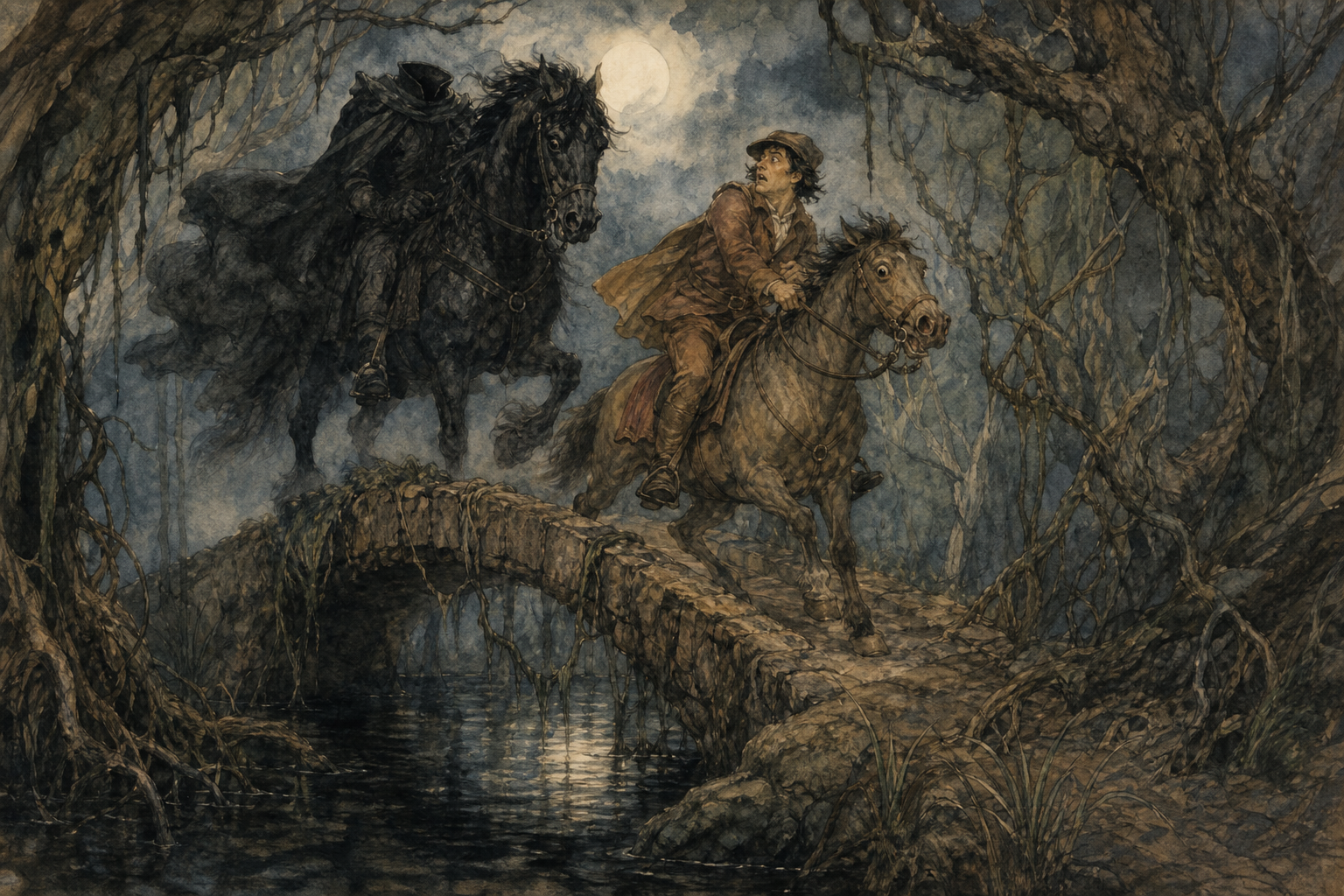
Ichabod coaxed and pushed. The horse slid into a gooseberry bush, jerked free, and then sprang forward only to stop abruptly right at the bridge. Ichabod nearly flew over its head. Then he heard a heavy, wet tramping in the shadow on the other side. Something large moved in the darkness. He tried a polite greeting. No answer. He dug his heels into the horse, began to sing a hymn to keep his courage up. Then the dark mass moved forward and blocked the road.
A large man on a large black horse stood there suddenly. He said nothing. He just rode alongside, exactly at Gunpowder's pace. Ichabod tried to hurry. The other hurried. He slowed. The other slowed. The silence between them grew heavy as lead. On a hill, the silhouette became clear. The man had a cloak that flapped. Ichabod looked at his shoulders to see his face. There was none.
The rider's head was not on his body. It lay on the saddle, pressed against the pommel, like a dark ball. Ichabod tensed completely. He thought of Brom's story about the race and the Hessian. He gave Gunpowder his head. The horse sprang. The black horse followed, silently except for the hard hoofbeats.
Stones flew. Sparks flew from the road. Ichabod's coat flapped like wings. He lay flat along the horse's neck and whispered prayers. The road forked. One way went, as boys usually took, to the right toward farms. The other swung left, down a sandy lane that led toward the church and the bridge. Gunpowder chose left, as if he knew better than his rider.
Down in the hollow, the wind cut cold. The saddle girths, old and rotten, began to give way from the jouncing. Suddenly the saddle slipped. Ichabod clung to the horse's neck. The saddle fell, trampled flat by the black horse. A sharp thought shot through his mind: Hans Van Ripper's precious Sunday saddle! But there was no time to fear that man's wrath. The real danger breathed on his neck. Ahead, water glinted. Behind, the breath of the pursuer's horse was like a bellows. If only he could reach the church bridge, legend said, the ghost dared not follow.
The branches opened. The church lay pale and low behind some trees, white in the dimness. The creek lay between. The little wooden bridge was right ahead. Ichabod spurred his horse onto the planks. The thunder beneath him was like drums. He was across! He dared to glance back, ready to see the headless one dissolve into smoke and light, as people said the ghost must.
But the rider did not vanish. He rose in his stirrups and hurled what he carried. It flew through the air like a dark ball with a stem. Ichabod ducked, but too late. The head—or what he thought was a head—hit him square in the forehead and chest with a thud like a gunshot. He tumbled off Gunpowder and into the dust. He had time to hear the hoofbeats thunder on. The black horse, the Headless Horseman, and his own nag were gone in the same direction, swallowed by the night mist and the broad trees.
The night was silent again. The creek babbled as if nothing had happened. The church stood as before, white and still. The moon's pale face moved on between clouds. No one could say that night where Ichabod Crane was, or what hand had thrown the thing that struck him down.
At dawn, Gunpowder stood at Hans Van Ripper's gate, nibbling grass. The reins trailed under a hoof. The saddle was gone. Van Ripper did not like what he saw. He cared little for schoolmasters, but the saddle was his, and expensive. He took neighbors and searched.
They soon found the broken saddle, trampled and muddy on the road toward the church. Hoofprints at full speed pointed the same way. By a dark bend in the creek, beyond the bridge, they found Ichabod's hat. Not far away lay a pumpkin, smashed. They dragged the creek with rakes and poles. No body floated up. No groan came from the thicket.
Van Ripper went to the schoolhouse. He took charge of Ichabod's belongings, like an executor. There was not much. Two and a half shirts. Some knitted stockings. A pair of corduroy breeches. A rusty razor. A hymnbook with corners chewed by weevils. A little broken flute. Among the books by the desk, he found Cotton Mather's account of witches, an almanac, and a book of dreams and omens. He also found a little poem about Katrina, stained with ink. Van Ripper shook his head, called it nonsense, and straightway burned everything he thought might attract evil thoughts. He said his children would attend school no more. The last quarter of school fees was certainly not in the bundle.
The news of the disappearance spread quickly. On Sunday, people stood in clusters by the churchyard and the bridge. They talked and pointed. They told each other Brouwer's old story anew, and Brom's. They compared signs and traces. Most finally agreed: The Headless Horseman had carried off Ichabod Crane.
Life went on, however. The school moved to another corner of the valley, and a new master rapped the desk. A few weeks later, a rumor came with a farmer who had been to New York. He thought he had met Ichabod alive. The story went like this: The schoolmaster, frightened both by ghosts and by Hans Van Ripper's wrath over the saddle, and humiliated by Katrina's refusal, had fled the same night. He later taught elsewhere, studied law, was admitted to the bar, wrote for newspapers, and ended up as a judge in a small court, Ten Pound Court.
Not everyone believed it. But soon after, Brom Bones married Katrina. When people told about the pumpkin found by the creek, Brom laughed loudly and looked knowing. That made some wonder if he knew more than he said. Had he played a trick on Ichabod? Had he, known for pranks and for riding the only mare as sly as himself, disguised himself and thrown a pumpkin instead of a head?
The old Dutch women shook off such explanations. They held to their own. For them, the Headless Hessian was as real as the mountain above them and the creek that flowed. They began to look at the bridge with new awe. The road was later moved so one no longer had to pass that spot in darkness. The schoolhouse that Ichabod had run rotted and collapsed. Some said that if you passed on a quiet evening, you could hear a thin, nasal hymn tune, far away, as if a frightened voice were still trying to sing itself brave.
Thus Sleepy Hollow gained a new story to add to the old ones. But it was not quite finished. It could be told in two ways, and both lived side by side. One was scary. The other was funny. That is often the way where people dwell.
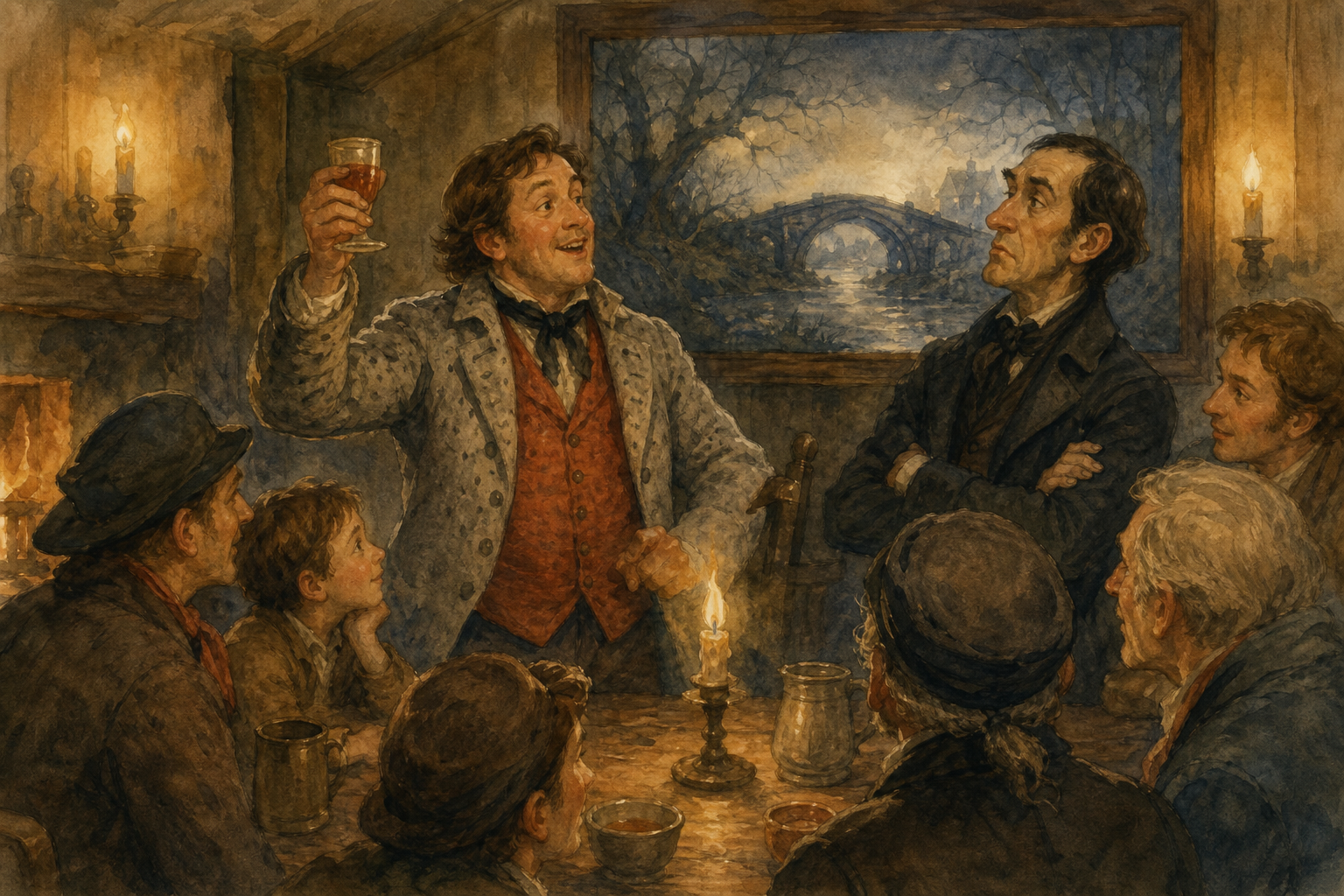
Knickerbocker, who tells this story further, adds a final bit. He says he heard the tale almost word for word in a meetinghouse in the old city of Manhattoes, which people now call New York. A man in a shabby but neat pepper-and-salt coat told it. He was cultured and cheerful, and the aldermen who listened laughed until they held their sides, and slept through what they could not laugh at.
When he finished, a tall, cautious gentleman rose, thin as a twig and precise about right and wrong. He asked sternly what the story proved. What was the use? The storyteller raised his wineglass and answered, as solemnly as if reading the law, that it proved that every station has its pleasure, if we only take the jest when it comes. That he who races ghost riders must be prepared for a rough ride. And that a schoolmaster refused by a Dutch heiress might as well aim for higher office elsewhere.
The cautious gentleman frowned. He did not think that was enough. The storyteller looked almost triumphant and added that he did not believe half of what he himself had said. For who can say for sure what the night's darkness hides, what a jealous suitor may devise, or how far a frightened man may run when he hears hoofbeats behind him?
So the story ends as it began, half in jest and half in shadow. In Sleepy Hollow, reason, appetite, and superstition run side by side. They all race toward the same little bridge, into the same dark hollow. And the truth? It rides along, perhaps pressed against a saddle pommel like a head without a body, always just out of reach of the one who would grasp it.